MC
michael carbajales-dale
Clemson University
Clemson, United States
336
Total views and downloads
Submit your idea
You will be redirected to our submission process.
Manuscript Submission Deadline 10 October 2026
This Research Topic is currently accepting articles
Our planet is warming at an unprecedented rate. In 2024, global temperatures reached a new record high, with the annual mean temporarily exceeding 1.5 °C above pre-industrial levels, highlighting the proximity to a critical threshold identified in the Paris Agreement.
Impacts from climate change include:
• Rising temperatures, which heighten heatwaves, harming health and productivity; extend warm nights, stressing crops; affect snowmelt, reducing downstream irrigation; shift crop and insect zones; and boost wildfire risk.
• Changing precipitation patterns, including intensified rainfall that triggers floods, erosion, and damage, while droughts cut water supply, threaten food security, disrupt planting schedules.
• Sea level rise increases flooding in low-lying areas, accelerates coastal erosion, causes saltwater intrusion into aquifers, and amplifies storm-surge impacts.
• Extreme weather events, including tropical cyclones, hurricanes, hailstorms, and compound hazards, are increasing in intensity, leading to greater wind damage, flooding, crop losses, and recovery challenges.
• Ecosystem and biodiversity disruptions such as, species shifting or vanishing, pollinator breeding cycles becoming misaligned with changing flower seasons, coral bleaching, and forests dying from heat, drought, pests.
• Urban and infrastructure challenges such as, increased urban heat island effect, stormwater systems overload, accelerated infrastructure decay, and overloaded power grids buckling during extreme heat.
The Intergovernmental Panel on Climate Change (IPCC) has recognized the need for climate resilient development that combines both mitigation techniques to reduce greenhouse gas (GHG) emissions and adaptation strategies to reduce society’s vulnerability to climate change impacts . Technologies that simultaneously support mitigation and adaptation for climate resilience are collectively referred to here as Climate SMART solutions.
Goals:
This Research Topic invites submissions related to Climate SMART interventions, including but not limited to:
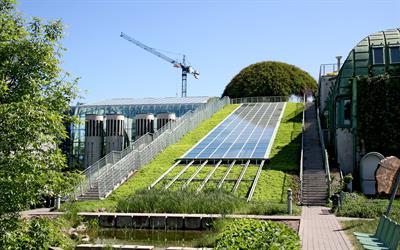
• Urban system and built environment, including urban design, land-use planning, green buildings, and infrastructure such as cool roofs, street canyons, green corridors, passive design, improved insulation, water reuse, and integrated renewables
• Transportation, including public transit hubs, dedicated bus lanes, cycling infrastructure, electrification, and the resilience benefits of vehicle-to-grid systems
• Energy systems and emerging technologies, including agrivoltaics, offshore wind with co-benefits (e.g., storm mitigation), distributed energy systems, and climate intervention approaches such as marine cloud brightening
• Waste management and circular economy, including composting or anaerobic digestion of organics to curb methane and regenerate soils
• Integrated energy systems, such as agrivoltaics, offshore wind with storm mitigation potential, and seawater aerosolization for marine cloud brightening
• Agriculture and food system, including dietary shifts (e.g., reduced meat consumption), regenerative and low-input agriculture, cover cropping, and sustainable intensification
• Land and ecosystem management practices, including reforestation, wetland and mangrove restoration, urban forestry, and innovative approaches such as subsurface biomass carbon sequestration. Climate policy, governance and behavior, including community engagement, education programs, institutional frameworks, and incentive mechanisms that support Climate SMART adoption
• Data, monitoring, and decision-support systems, including remote sensing, AI/ML applications, MRV (measurement, reporting, verification), and integrated assessment tools
• Equity, adaptation, and co-benefits, including climate justice, health impacts, resilience planning, and socio-economic trade-offs of Climate SMART interventions
Instructions for authors:
We particularly welcome submissions that go beyond single-technology assessments to quantify co-benefits and trade-offs across mitigation, adaptation, resilience, and equity dimensions. We invite original research articles, reviews , perspectives, and comments.
Relevant approaches include experimental and/or field studies, modeling, empirical case studies, techno-economic analysis (TEA), life-cycle assessment (LCA), policy analysis, quantitative evidence synthesis (including meta-analysis), and comparative system-level evaluations.
We are particularly interested in contributions aligned with the UN 2030 Agenda for Sustainable Development, including SDG 6 (clean water and sanitation), SDG 7 (affordable and clean energy), SDG 9 (industry, innovation, and infrastructure), SDG 11 (sustainable cities and communities), SDG 12 (responsible consumption and production), SDG 13 (climate action), SDG 14 (life below water), SDG 15 (life on land), and SDG 17 (partnerships for the goals).
This Research Topic accepts the following article types, unless otherwise specified in the Research Topic description:
Articles that are accepted for publication by our external editors following rigorous peer review incur a publishing fee charged to Authors, institutions, or funders.
Keywords: Integrated energy systems, Decarbonization, Climate mitigation, Grid resilience, Climate adaptation, Climate SMART interventions
Important note: All contributions to this Research Topic must be within the scope of the section and journal to which they are submitted, as defined in their mission statements. Frontiers reserves the right to guide an out-of-scope manuscript to a more suitable section or journal at any stage of peer review.
Clemson University
Clemson, United States
University of Illinois at Urbana-Champaign
Champaign, United States
Department of Environmental Engineering and Earth Sciences, College of Engineering, Computing and Applied Sciences, Clemson University
Clemson, United States
College of Engineering, Computing and Applied Sciences, Clemson University
Clemson, United States
Clemson University
Clemson, United States
Manuscripts can be submitted to this Research Topic via the main journal or any other participating journal.
Submit your idea
You will be redirected to our submission process.
