- Science news
- Frontiers updates
- How do you know you can trust the science you read?
How do you know you can trust the science you read?
It doesn’t happen by chance. Behind every article published in a Frontiers journal lies a structured, rigorous, seven-stage journey designed to safeguard integrity and protect the scientific record.
At a time when scientific publishing faces growing challenges - from AI-generated and manufactured manuscripts to coordinated fraud - maintaining confidence in research has never been more important, demanding increasing vigilance at every step.
So, what happens between an author clicking ‘submit’ and a study being published?
Discover the journey every manuscript takes before publication at Frontiers - and the safeguards that protect its integrity and quality at scale.
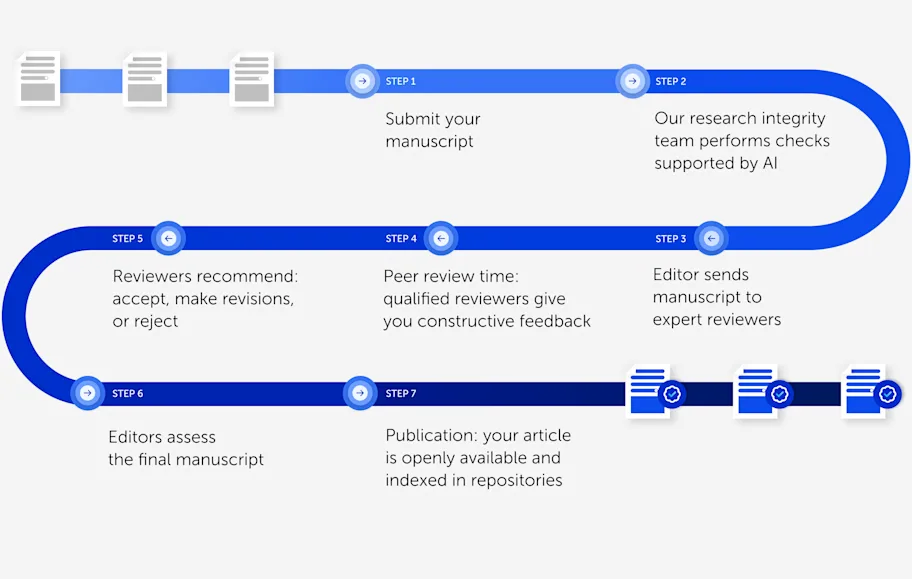
Step 1: Submission
After selecting the most relevant journal or Research Topic, a researcher uploads their manuscript, declares conflicts of interest, confirms data availability, and clicks submit.
For the author, this moment often represents months - sometimes years - of work. For the peer review it’s just the beginning.
"It often is an iterative process, and that iteration most often greatly improves the paper. And that's what we're trying to do as well. We're trying to help authors develop their work into a condition that is publishable. "
said Martin Siegert, Field Chief Editor at Frontiers in Environmental Science
Step 2: Research integrity checks supported by AI
Before a submission reaches an editor, it undergoes extensive integrity and quality checks performed by Frontiers' research integrity team, supported by AIRA, our AI-powered review assistant.
AIRA runs more than 40 AI-powered quality checks, flagging potential issues for human review on issues ranging from ethical compliance and plagiarism to signs of image manipulation, and paper mill activity. As submission volumes rise and bad actors grow more sophisticated, this screening has become essential to preserving meaningful human review.
For Johannes le Coutre, Field Chief Editor of Frontiers in Nutrition, the value of this early filtering is clear:
"AIRA is doing a fantastic job to weed out and reduce the amount of low-quality material coming in, in order to keep the brains of all editors free and clear for those submissions that deserve close attention."
AIRA doesn't replace editorial judgment, it helps focus it where it matters most.
Step 3: Initial editor check
Papers that pass the initial integrity checks are then reviewed by a handling editor - a working scientist with expertise in the paper's specific field. Their first task is to answer a fundamental question: does this paper belong here?
Scope decisions are more complex than they appear. Each journal section has a defined intellectual territory, and maintaining those boundaries preserves credibility.
Then the editor must identify whether the manuscript is scientifically robust by answering these questions: Do the methods adequately answer the questions? Are the results reported in a verifiable way? Do conclusions match the evidence?
If a manuscript meets these requirements, the editor will send the submission to suitable expert reviewers.
Step 4: Peer review
This is when science itself is carefully evaluated. Independent and qualified expert reviewers - scientists with direct expertise in the paper's subject - provide detailed, constructive feedback. As with any expert evaluation, reviewer opinions may differ. Arch Mainous, Specialty Chief Editor at Frontiers in Primary Care, has seen this firsthand:
"Reviewer A may say, 'I think this is great.' And reviewer B says, ' I think that this has fatal flaws.' And that's where the editor has to look at it and say - I agree with reviewer A, or I agree with reviewer B, or I will come up with something completely different."
This divergence reflects the genuine complexity of evaluating new science.
Step 5: Interactive review
Reviewers can recommend acceptance, minor or major revisions, or rejection — each outcome providing important signals about the manuscript’s strengths and weaknesses.
If the peer review team recommends revisions, a unique interactive review phase begins. Authors are invited to respond to critiques, clarify methods, strengthen analyses, refine interpretations, and address gaps. Through the online collaborative review forum, reviewers can elaborate on their concerns, ask follow-up questions, and ensure that responses meaningfully resolve the issues raised.
The handling editor oversees this exchange to ensure that the dialogue remains focused, fair, and scientifically rigorous.
“We have the forum where we interact with authors at an increasingly open level to make sure, they can address the comments that had been put into place by reviewers.”
said Johannes le Coutre, Field Chief Editor at Frontiers in Nutrition
This is often where manuscripts become significantly stronger. Claims are moderated, statistics are tightened, and transparency improves. In short: the science is refined.
Step 6: Editors assess the final manuscript
Before any paper is accepted for publication, editors conduct a final assessment of the complete manuscript. It is here that human editorial judgment takes final responsibility for the decision.
The editor weighs the totality of the evidence - the science itself, the peer review dialogue, the revisions, and the broader contribution to the field - and decides whether the manuscript meets the journal’s standards for publication.
“People need the guardrails of expertise to know that this is good information,” says Thomas Hartung, Field Chief Editor at Frontiers in Artificial Intelligence
Final editorial assessment is that guardrail.
It’s the point at which a manuscript becomes something more than a submission. It becomes part of the permanent, citable body of scientific knowledge.
Step 7: Publication
When a paper clears all these gates, it is published, and freely accessible to anyone in the world.
Frontiers ensures that accepted papers are indexed in major repositories, making them discoverable and citable. Where appropriate, newsworthy findings are actively promoted to global media, extending their reach far beyond the scientific community.
Martin Siegert, Field Chief Editor at Frontiers in Environmental Science, sees this distribution as inseparable from the integrity work that precedes it:
"We want to influence policy. And that's where Frontiers comes into its own - we can put that paper out in an open science way, free of charge to anybody who wants to take a look at it."
Seven steps, one purpose
The time between ‘submitted’ and ‘published’ is critical in ensuring research can be trusted.
Every step in the above process exists because science - the kind that shapes medicine, informs policy, and advances human knowledge - requires more than a significant P value and a well-formatted bibliography. It requires questions worth asking, methods worth trusting, and conclusions worth building on.
As Arch Mainous, Specialty Chief Editor at Family Medicine and Primary Care, puts it, with the clarity of someone who has spent decades on both sides of the process:
"The job isn't to just process papers through the system. The job is to process new knowledge and get that out. We want the good stuff to rise to the top. We want to make sure that highly trustworthy information is being produced."